
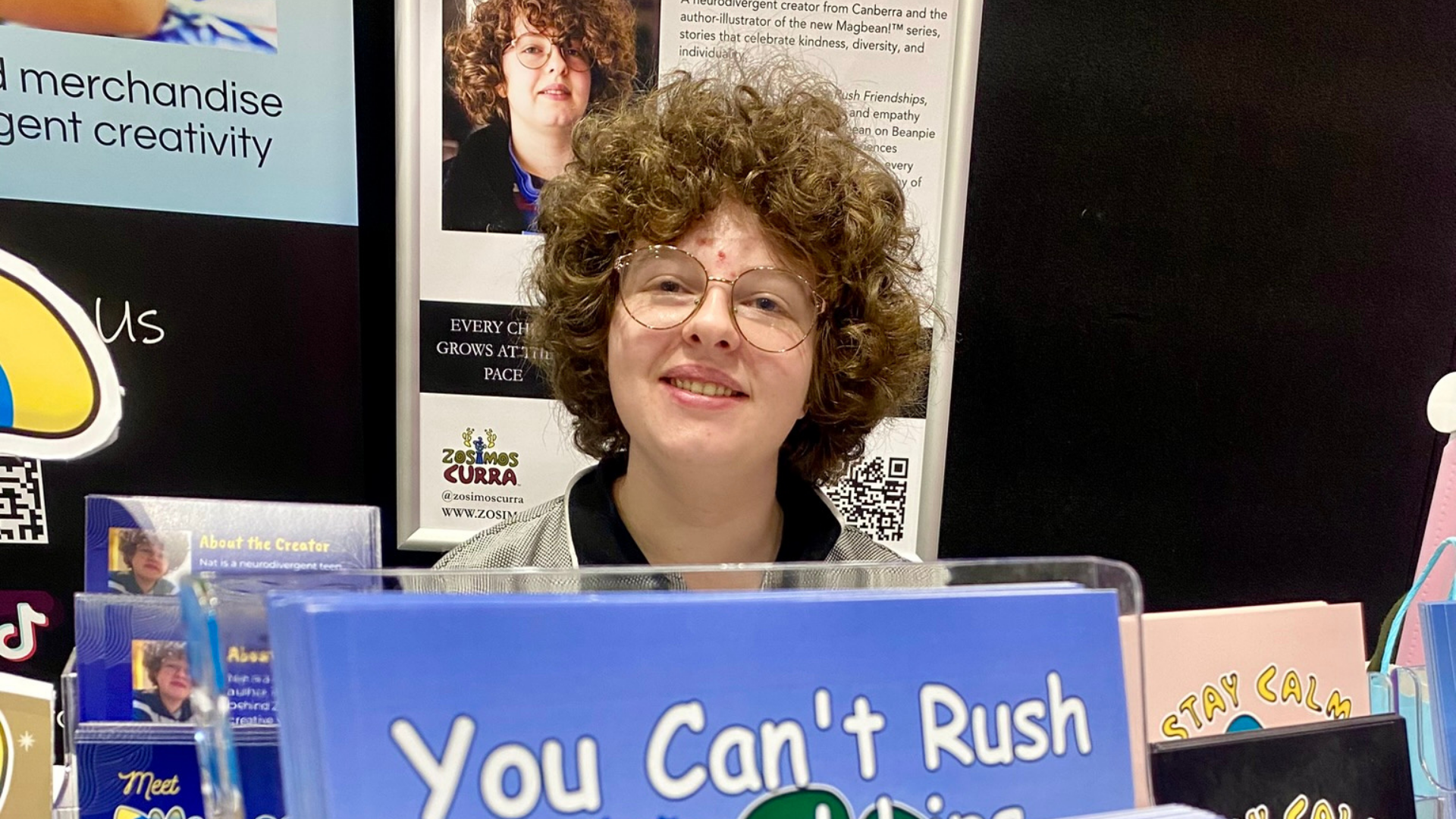

It started at dinner.
Nat Bannerman had been telling their mum Debi about their stories again. Not finished stories. The ones they kept coming back to, rewriting, restarting, circling without ever landing. Debi had heard about these stories before. She loved Nat with the full and unguarded devotion of a parent who is also, without qualification, their child’s number one fan. But on this particular evening, her patience found its edge.
Write ten pages, she said. Two sentences each.
Nat made it a challenge.
After dinner, they sat down and wrote “Magbean! You Can’t Rush Friendships”, a story about how two of their original characters, Magbean and Magbroccoli, first met. The book was based on a comic strip they had already made. The illustrations on pages two and three were drawn directly from that comic. And the story that had lived in Nat’s head for so long, restarting itself over and over, finally had an ending.
That moment, the completed page, the thing that now existed in the world and had not existed before, was the proudest of Nat’s creative life thus far.
Nat Bannerman was an author, an illustrator, and the founder of Zosimos Curra, an independent publishing business built on a quietly radical idea: that children of every age deserve stories made with care, specificity, and a genuine philosophy.
They were also, by their own cheerful admission, the kind of person who could not quite bring themselves to speak first to a stranger. “Introductories,” they noted in their interview, with characteristically precise phrasing, “highly depend on what subject is brought up.”
It is not difficult to understand why someone like that would let their characters do the talking instead.
There is a particular kind of creative mind that finds direct social interaction harder than the work of building whole worlds from scratch. For Nat, the page was where they were most fluent. Where observation could become story, and story could become something a child might carry with them long after the book was closed.
The Magbean books are gentle, warm, and specific in the way that only stories built from real attention can be. The characters are vegetables, which is both exactly as silly as it sounds and entirely beside the point. Magbean, Magbroccoli, Magtaco, Nachobean, Beanvine: each one distinct, each one carrying a piece of the philosophy Nat was working through.
Because there is a philosophy in these books. It is not stated in a foreword or spelled out in an author’s note. It lives in the choices the characters make. “Bad things give those the opportunity to learn and g row, even if not realised in the moment,” Nat said.
In “You Can’t Rush Friendships”, Magbean learns this after being yelled at by Magbroccoli. The lesson is not that the yelling was acceptable. It is that Magbean’s response to it can still lead somewhere good. In “Kindness Over Rudeness”, Beanvine offers to help two characters who had previously called them “lice”. The offer is not forgotten or minimised. It is the whole point.
“It is not always your fault that bad things happen, but you can always make a difference.
Nat told us.
Two ideas. Quietly revolutionary in a picture book format. Quietly revolutionary for anyone, of any age, who is sitting with something that has gone wrong and wondering what they are supposed to do with it.
But Magbean was never going to be the whole story.
Nat had mapped out an entire ecosystem. Different series, different age groups, each one organised with the same intent and care. The Magbean books sit in the 4-9 age bracket. A bird story in development at the time of interview, was recently published, for readers aged 10 and above. It’s titles 5 Cockatoos, a playful counting rhyme inspired by a real moment with five cheeky cockatoos. A lizard story, still in early thinking, possibly aimed at 15 and above. Each series would hold its own characters, its own world, its own reasons for existing.
“Zosimos Curra as a business will not make books for only one series or age group,” Nat said simply.
There was a whole library being built. A library where a child could start with Magbean at four and find, twelve years later, that there was still something in it for them. That the same creator who taught them about patience in friendship had kept going, kept making, kept finding new ways to say the things that matter.
Outside of the books, Nat drew constantly. The very first drawing they ever made was done with a texta, not a pencil, and something about that directness, that immediacy, never quite left. Drawing was how they unwound. How they reset after a long day. Character design, in particular, was something they returned to with genuine joy, the careful work of making a face that carries a whole personality in a handful of lines.
They also played rhythm games at a level that caused real bewilderment in online multiplayer spaces. Other players, watching Nat’s timing and precision, accused them more than once of hacking. Of scripting. Of somehow cheating their way to results that felt impossible. They were not cheating. They were simply, quietly, extraordinarily good.
And then there is the music.
Nat’s artistic style was cartoonish, warm, rounded, and full of colour. Their hearing was sensitive. Their favourite genre was metal. Their favourite band was a deathcore band, operating in one of the heaviest subgenres the form has to offer.
It is exactly the kind of contradiction that makes a person real, rather than a version of themselves they have edited for public consumption. The person who draws patient little vegetables navigating the complexity of new friendships also turns on the heaviest music they can find to feel the rhythm of it. Both things are true at once. Both things belong to Nat.
Nat Bannerman filled out this interview in December 2025. They wrote about the bird story and the lizard story in the future tense, because the future was, in every reasonable sense, still ahead of them.
They passed away unexpectedly in their sleep. The Coroner’s Office, after a thorough and careful investigation, recorded the cause as unascertained natural causes. There are no complete answers, only the particular grief of people who loved someone and did not get to say goodbye in the way that grief asks for, and the work that Nat left behind.
But, the work is still here.
The books exist. The characters exist. Magbean and Magbroccoli and Beanvine and the rest of them are still on those pages, still navigating friendship, still modelling, in the patient and specific way that Nat understood so well, that it is not always your fault when things go wrong, but you can always make a difference.
The library Nat was building is incomplete. But the philosophy they put into every character, the particular quality of attention they brought to the small and important moments of a young person’s inner life, does not disappear because they are no longer here to add to it.
Debi, who reached her limit at dinner one night and said simply, “write ten pages”, who then watched those ten pages become a book and a business and a whole vision for a publishing world she could see Nat building with quiet determination, is continuing to walk alongside their memory. She is keeping the legacy alive, one story at a time, with the same love she always had.
The kindest thing any of us can do with a story like Nat’s is to keep it in circulation. To make sure the books find their readers. To make sure the characters who carry their philosophy keep doing the work they were made to do.
That is how a quiet, precise, brilliant person who could not always speak first to a stranger continues to speak to the world.
Nat Bannerman’s books are published through Zosimos Curra. Find their titles and learn more about their work at zosimoscurra.com.au.