
Losing someone you love is devastating in ways words often fail to capture. But what I did not expect was losing myself in the aftermath. When Andy passed away, I was not just grieving his absence. I was grieving the person I had been when we were together. Our relationship was more than love. It was a partnership, a balance of strengths and quirks that made us feel invincible, even in the face of challenges. Without him, it felt as if a piece of me had gone for ever.
Andy and I were a team in every sense. His brilliance was in consuming vast amounts of information, synthesising it, and recalling every detail precisely. My strength was to bring that information to life, translating it into steps that considered people and the systems around them. Together we navigated life like a well-tuned orchestra. We had rhythm. We knew how to play to each other’s strengths. We found joy, even on dark days.
I remember one morning when that partnership sang. I was CEO of a mental health organisation and received a call to speak on radio about a government announcement. As I grabbed my keys, Andy, already halfway through his morning treatment routine, looked up and said, “On it.” By the time I reached the car he had read the media, the research, and the parliamentary statements. He called me with a crisp summary and a few anchor statistics. “You have got this,” he said. Ten minutes later I walked into the studio prepared, weaving data with lived stories. When I walked out my phone buzzed. “HB, you nailed it.” “We really are the best team,” I replied.
After he died, the silence was not only emotional. It was functional. The version of me shaped by our shared life suddenly felt hollow. I could not stop replaying that rhythm of preparation and purpose. Without him, even reading the news felt like wading through glue. Slowly, small tools helped. A daily podcast from his favourite outlet kept me company on the drive. It did not give me his view, but it reminded me I still had one.
That is where today’s piece begins, because grief literacy is not only for homes and hospitals. It belongs in our workplaces, too.
Why this matters at work
Teams carry many kinds of loss. Some are public and acknowledged, like the death of a loved one or a colleague. Others hide in plain sight. Restructure and role change. A difficult diagnosis. Caring responsibilities. Separation. Migration. Natural disasters. Even the loss of future plans.
Grief literacy at work is about recognising those invisible loads and giving people practical scaffolding so they do not have to carry them alone. It is not about lowering standards. It is about building conditions where people can do meaningful work while being human.
Two myths to retire
Myth 1: Grief has stages to complete. Modern grief science does not support fixed, linear stages. Most of us oscillate. We adapt, re-adapt, and weave the loss into life over time. Australian grief scholars have been clear about this for years, calling out the unhelpful language of “closure” and reminding us that accommodation, not completion, is the task.
Myth 2: There is a deadline to be “over it”. For a small proportion of people, grief remains intense and impairing for a long time. This is known as prolonged grief disorder and it deserves targeted, evidence-based care. Recent work led by UNSW shows that while both mindfulness-based approaches and cognitive behaviour therapy can help in the short term, grief-focused CBT delivers more durable benefits over time. That is a signal to leaders and HR to keep pathways to proper care visible.
Holding these truths changes how we design work. Instead of demanding a neat arc back to “normal”, we can offer steady routines, flexible pacing, and permission to be human while the work continues.
What grief taught me about leadership
Grief stripped my leadership of pretense and left the parts that matter.
Reframing success. Before Andy, I thought success was the climb. Milestones. Accolades. After Andy, I learned to value relationships over trophies, presence over productivity, meaning over material wins. That shift has made me a steadier person, a more compassionate leader, and a more thoughtful advocate.
Calm in the storm. Crisis decision-making became second nature. Medical emergencies and treatment changes taught me to triage quickly, choose the next step with incomplete information, and act while acknowledging the emotional fallout. Leadership often asks for the same. You hold the room, make the call, and keep sight of the human cost.
Make space for emotions. I had to learn not to rush to fix. To name and validate feelings in the room and let them be present without taking over the agenda. Teams notice when you do this. Tension drops. Trust climbs.
Empathy is a performance tool. This is not “soft”. Deep listening is how you uncover constraints, surface risks early, and create psychological safety for honest feedback. The result is better decisions and fewer surprises.
Authenticity. Caring for Andy stripped away my armour. Real strength is not invincibility. It is showing up, being clear about constraints, and modelling honesty so others can do the same.
Collaboration by default. Our partnership taught me to empower strengths around me. Leadership is not having all the answers. It is building the conditions where answers emerge from the group.
Community building as a superpower. The work I am most proud of brings isolated people together. In organisations, that looks like cross-team rituals, peer support, and making sure no one is left to carry heavy loads alone.
Practical moves managers can use this week
These are small, repeatable behaviours. None require a policy overhaul.
- Check-ins with agency. Open 1:1s with “How would you like me to support you this week?” It invites control and clarifies the ask.
- Load visibility. Use a two-column ritual: “What I can carry / What I need covered”. Review it briefly, make a decision, and document who covers what.
- Flexible cadence. Shorten meetings. Allow switch-off time after difficult appointments. Move non-critical deadlines where possible.
- Predictable rituals. After difficult news, schedule a short stand-down. Protect a weekly meeting-free focus block. Predictability reduces cognitive load.
- Buddy systems. Pair people for shadowing and handover. It reduces the single point of failure and lowers the stress of stepping away.
- Documentation over heroics. Clear notes and shared trackers mean teammates can step in without guesswork. This is kindness disguised as ops.
- Pathways to proper care. Make your EAP or local options visible and stigma-free. Which means using these services yourself!
If you are designing organisation-wide support, know the field is maturing in Australia but policy still varies. That is more reason for leaders to act with consistency and care in their own teams.
Language that lightens
Simple swap-outs help colleagues feel seen.
- “No need to reply today. I am just checking that you are supported.”
- “What can we pause or pass on for now?”
- “Would you like me to listen, problem-solve, or simply note this for later?”
- “What would make the week feel more doable?”
Grief-literate workplaces build grief-literate communities
Workplaces are part of the social fabric of our city. When we respond well to loss at work, we model what it looks like in families, clubs, faith groups, and neighbourhoods. Australian universities have led on a public-health approach to death, dying, and bereavement, often called “compassionate communities”. La Trobe University’s Healthy End of Life Project (HELP) is one example. It is a practical framework for building community capability around end of life, including bereavement. The core idea is simple. Skills and care do not live only in clinics. They belong in everyday relationships, and that includes our teams.
Grief literacy sits within that vision. Curtin University’s researchers, including Professor Lauren Breen, have been central in defining grief literacy and calling for communities—and by extension workplaces—to understand grief, talk about it, and respond in ways that are informed and compassionate. That means myth-busting, normalising help-seeking, and giving people practical tools rather than platitudes.
A service you may not even know about. If your workplace is ever touched by suicide, even indirectly, StandBy Support After Suicide is a national, government-funded program your leaders should know about. It provides free, coordinated postvention support 24/7 for anyone bereaved or impacted. StandBy also offers workplace-specific resources, from a practical Workplace Toolkit to a Postvention Toolkit for Site Owners and Leadership (co-developed with Lifeline) to guide your response, communications and staff care following a suicide, so you are not relying on ad-hoc goodwill in the hardest moments. Make sure you note this service for when you need it.
A small tool you can keep on your phone
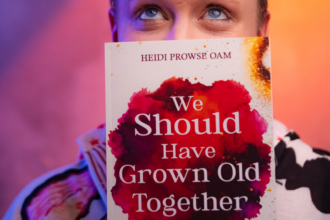
When I wrote We Should Have Grown Old Together, I did not set out to write a book with capital letters. I wrote stories, speeches, notes in my phone. Lines I wish someone had said out loud. Questions that were easier to face on paper than in a crowded room. Over time those scraps became a small companion for hard days.
Here is how managers and colleagues have told me they use it.
- To open a 1:1 when words are hard. Choose a prompt, read it together, and let it guide the check-in.
- To follow tough news. Share a page privately with a colleague who has just received difficult information. No “shoulds”, only support.
- To steady change briefings. When rolling out restructure or role shifts, use a short reflection first. It signals you are holding both task and tenderness.
For some readers, a book will be enough for now. For others, it will be a bridge to professional support.
Closing with care
I still miss the rhythm Andy and I created. I still have days where the world moves and I cannot. That is how love reorganises itself. If you are carrying something like this, you are not broken. You are human, doing your best to work, care, and keep going.
We do not need perfect words at work. We need steady ones. We need small, predictable acts of care. We need leaders who will hold the room while we find the next step.