When the finalists for the 2026 ACT Women’s Awards were announced, there were a few names that immediately made us smile.
Not simply because Raffy Sgroi, Katherine “Kat” Berney and Robyn Smith are deserving finalists, they absolutely are, but because Purpose Media has had the privilege of sitting with each of them before the award spotlight arrived.
We’ve heard the longer version of their stories.
The version that doesn’t always fit neatly into an awards citation.
The late-night phone calls. The lived experience that became advocacy. The doors quietly opened for someone else. The years of persistence behind changes that can eventually look inevitable.
And perhaps that is one of the lovely things about awards like these: they give our community a reason to stop and look at people whose work has often been happening for a very long time.
The refreshed 2026 ACT Women’s Awards recognise impact across industry, research, advocacy, community leadership and social change. Eleven women and gender-diverse people have been named finalists this year, with winners to be announced on 3 September.
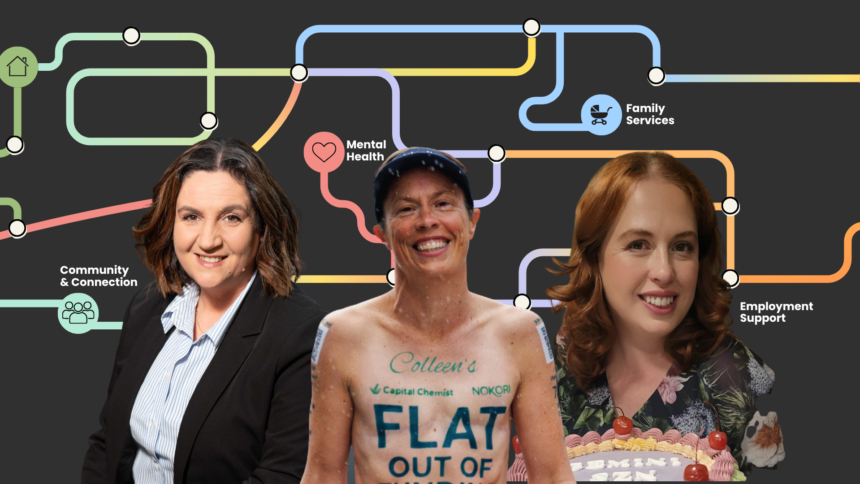
Among them are three women whose stories have already appeared in Purpose Media’s People with Purpose series.
Raffy Sgroi: when helping others becomes a way of life
The ACT Government describes Raffy Sgroi as an automotive industry leader who has created education, training and employment pathways supporting women and underrepresented groups to enter and thrive in the automotive sector.
That is true.
But spend time with Raffy and you quickly realise the automotive work is only one expression of something much bigger.
When we first shared Raffy’s story, we met a woman building inclusion from inside a family-run mechanical workshop while simultaneously building a community of women through HerZest. At Car Mechanical Services, Raffy has helped create practical pathways for women and people with disability into a traditionally male-dominated industry. HerZest, meanwhile, grew from her desire to stop women doing remarkable things in isolation and instead connect them into a genuine community.
Her motivation is rarely about being the person in front.
It is about who else gets to come through the door.
Raffy told Purpose Media that the achievements she valued most weren’t trophies. They were things like watching a young woman with intellectual disability confidently working behind a front desk, seeing students feel genuinely welcomed in a workplace, or seeing another woman leave an event standing a little taller than when she arrived.
And then there is everything beyond the business.
Raffy is the kind of person who seems to continually find another place where she can contribute — mentoring women, connecting people across cultures and industries, volunteering her time and supporting organisations and initiatives around Canberra.
She does all of that while being a mum, a carer, running businesses and navigating her own chronic illness.
When we profiled her, one line seemed to capture her beautifully: Raffy’s joy is watching other people win.
That is the part of leadership an award citation can struggle to capture.
Sometimes impact is a program or a policy.
Sometimes it is simply being the person who consistently answers the phone.
Katherine “Kat” Berney: turning survival into systems change
Kat Berney is recognised by the ACT Women’s Awards for her influence on national policy reform and systems change to improve women’s safety.
Purpose Media readers know another important part of that story.
Kat’s professional expertise is intertwined with lived experience.
She is a survivor of domestic abuse, and when we spoke with her earlier this year, she described how having a strong family around her helped her recover — while also recognising that many people experiencing violence do not have the same support.
That question became part of her purpose: what happens to people who don’t?
Today Kat works in the prevention of gendered violence, seeking to change the structures, norms and systems that allow violence to occur and become normalised. Her focus is not only on what happens after somebody experiences harm, but on what our communities can do much earlier to prevent that harm in the first place.
There is something particularly powerful about prevention work because success can be almost invisible.
A crisis that never happens does not make a headline.
A person who feels safe enough to speak may never know which policy conversation helped create that environment.
A cultural norm can shift slowly enough that, eventually, we forget it was ever different.
Kat told us she wanted people who have lived with violence to experience lives defined by more than survival.
Her ambition is thriving.
She has taken something intensely personal and used it not to centre herself, but to ask bigger questions about the systems surrounding everyone else.
Yet one of our favourite things about Kat’s story was discovering how much else sits alongside that serious work.
She is a former opera singer. She finds joy in music, walking her groodle Lucy, dancing and baking. She believes deeply in kindness. And she carries an optimism that feels particularly meaningful given the work she does.
Her story reminded us that people working on difficult issues are not defined solely by those issues.
And neither are survivors.
Robyn Smith: making an invisible health risk visible
Robyn Smith is a finalist for her national advocacy improving education, psychosocial support and policy outcomes for people living with inherited cancer risk.
For Robyn, that work began in her own family.
After losing both her mother and grandmother to cancer, Robyn discovered that her family carried a BRCA2 gene mutation.
It meant confronting something unusual and confronting: being healthy while knowing you carry an elevated risk of developing cancer.
Instead of allowing that knowledge to remain a private family experience, Robyn turned it outward.
Through her work with Inherited Cancer Australia, she has helped people understand genetic testing, navigate risk-reducing procedures, access support and make extraordinarily personal decisions about their health and future.
When Purpose Media shared Robyn’s story, we described her work as bringing visibility, voice and vigilance to inherited cancer risk.
That still feels right.
Because much of what Robyn advocates for exists in an uncomfortable space between prevention and illness.
People may not have cancer.
But they may be undergoing major surgeries.
They may be deciding whether to remove healthy breasts, ovaries or other organs.
They may be carrying anxiety about whether their children have inherited the same genetic mutation.
And they may be navigating all of that without the kind of psychosocial or financial support generally associated with a cancer diagnosis.
Robyn has helped bring those experiences into public view.
She has also been willing to make herself extraordinarily visible in the process.
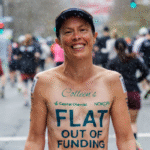
That includes using her own body and story to challenge stigma around mastectomy and prevention — including completing Canberra’s City2Surf-style running event with her mastectomy scars visible, turning an intensely personal experience into a public invitation to talk differently about women’s bodies, cancer risk and healthcare.
The attention-grabbing moment matters.
But what sits behind it matters more.
Every conversation Robyn starts has the potential to make someone ask about their family history, seek genetic counselling, speak with their GP or access healthcare earlier.
That is advocacy becoming action.
What awards don’t always show us
There are eight other finalists in this year’s ACT Women’s Awards, doing extraordinary work across construction, housing, STEM, corrections, nursing and aged care, culturally inclusive sport, Defence, and domestic and family violence advocacy.
They deserve to be celebrated too.
But Raffy, Kat and Robyn remind us why Purpose Media started telling People with Purpose stories in the first place.
Because achievement rarely begins when somebody receives an award.
Usually, by then, there have been years of unseen work.
The meeting where someone kept advocating after everyone else was tired.
The phone call made on behalf of someone who didn’t know where to start.
The decision to turn a painful personal experience into something that might make another person’s path easier.
The mentor who says, come with me.
The person who notices a gap and quietly starts filling it.
Awards give us a spotlight.
Stories help us see what exists beyond it.
So, yes, we are very excited to see Raffy Sgroi, Katherine Berney and Robyn Smith among this year’s ACT Women’s Awards finalists.
But perhaps even more importantly, we are grateful that they trusted Purpose Media to tell us a little more about who they are when nobody is handing them a trophy.
Because that is often where you find the purpose.
The winners of the 2026 ACT Women’s Awards will be announced on 3 September 2026.
Read our original People with Purpose stories: Raffy Sgroi, Katherine “Kat” Berney and Robyn Smith.