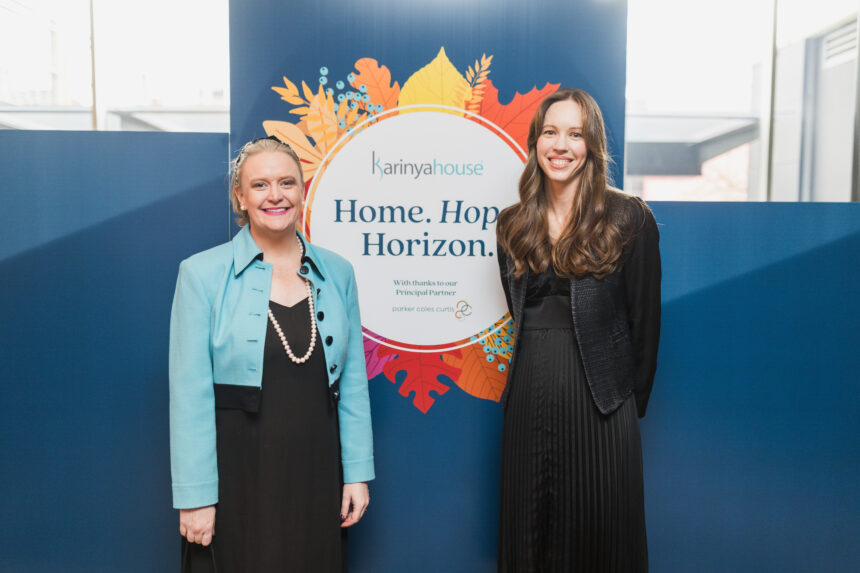
Sometimes, hope looks like a phone being answered. A door staying open. A support worker having enough time to sit beside someone. A community choosing to be useful. When more than 360 members of Canberra’s community gathered at the 2026 Home. Hope. Horizon. Charity Luncheon, a day filled with generosity, connection and a clear reminder that hope is not an abstract idea.
Hosted by Karinya House, the annual luncheon brought together supporters, donors, friends, advocates and community leaders in support of women, babies and families across Canberra and the surrounding region.
The afternoon reflected what Karinya House has long stood for: practical care, deep respect, and walking alongside women during some of the most vulnerable moments in their lives.
Karinya House Chief Executive Officer Lavinia Tyrrel later described the afternoon as “wonderful”, acknowledging the more than 360 people who attended, donated, bid in the auction, shared conversations and helped create such a warm and uplifting atmosphere.
Thanks to the incredible support of the community, the luncheon and donations to the May Appeal brought Karinya House close to its goal of $150,000. That amount is enough to support, on average, eight women and their babies and children with the practical and personal support they need most. This may include help with health and wellbeing costs, food, tenancy support, transport, independence, and pathways to study or work.
It is easy at events like this to focus on the final figure. The number matters, of course. Care costs money. Safety costs money. Practical support costs money. But the deeper story of the afternoon was what that generosity makes possible.
The keynote address was delivered by Heidi Prowse OAM, founder of Purpose Media CBR, who spoke not as the author of the event, but as someone who has lived the difference that advocacy, systems navigation and community support can make.
Her speech began with grief, but it was not a speech about grief. It began with the loss of her late husband, Andy, and the deep loneliness of reaching for someone who is no longer there. She described grief as more than sadness. Grief, she said, is reaching for the person who helped you carry hard things and realising they are no longer beside you to carry the hardest thing of all.
From that place, she took the room into a broader truth: every person, at some point, will face something too heavy, too complicated, too frightening or too unfair to carry alone.
In those moments, what changes everything is not always a perfect answer. Sometimes it is someone standing beside you and saying, “I am here. I am not leaving. We will work this out together.”
That became the heart of the keynote. Everyone needs someone.

With honesty, humour and emotional precision, Heidi shared how loving someone with a complex chronic illness meant learning systems she had never asked to enter. She spoke about becoming Andy’s advocate in hospitals, learning the language of care, asking questions, taking notes, challenging decisions and knowing when to push. Not because she knew more than the doctors, but because she knew Andy.
One of the most powerful moments in the speech came through a story about Andy refusing to be treated as a practice run when a junior doctor came to insert an IV line. Heidi recalled initially feeling uncomfortable with his directness, until Andy explained that every missed attempt could affect future access to treatment.
“My veins matter,” he told her.
It was one of the first times Heidi understood patient-centred care not as a phrase, but as a lived reality. For a clinician, a task may be routine. For the person in the bed, it may shape what treatment remains possible in the future.
The speech explored how systems can fail, not always through cruelty, but through busyness, forms, policies and assumptions that do not fit the person in front of them. It was a message deeply aligned with Karinya House’s work, because the women Karinya walks alongside are often navigating multiple systems at once, including housing, health, safety, income, pregnancy, parenting and family support.
Heidi then paused the room on an important point. She and Andy were capable. They were educated, articulate and supported. They had housing, family, community and each other. They still found the system exhausting, frightening and hard to navigate.
So, what happens when someone does not have that?
Heidi Prowse OAM
What happens when you are pregnant and alone? When you are unsafe? When you are standing on the tightrope and there is no one holding your hand?
That, she said, is where Karinya House steps in.
The keynote positioned Karinya House not simply as a service, a building, or a program with forms and case notes. It described Karinya as a hand. A steady hand. A practical hand. A hand that helps a mother move from fear to safety, from isolation to connection, from crisis to possibility, and from surviving today to imagining tomorrow.
That is home. That is hope. That is horizon.
For Purpose Media CBR, the event also spoke to a wider community truth. Services like Karinya House are not “nice to have”. They are part of the infrastructure of a caring city.
We often think of infrastructure as roads, buildings, hospitals and transport. But communities are also held together by quieter forms of infrastructure: trust, information, advocacy, relationships, lived wisdom and services that know how to meet a person before everything collapses.
Heidi’s keynote named this clearly. Stories are not soft. Stories are bridges, signposts and invitations. They help people understand where help exists. They help a community see the work that too often happens out of sight. They help someone sitting at home realise they are not the only one, and that there may be a door they can walk through.
In this case, that door is Karinya House.
The response in the room suggested the message landed deeply. One attendee later described the luncheon as “everything it needed to be and more”, praising the venue, food, atmosphere, Genevieve Jacobs’ warmth and wit as MC, Heidi’s keynote, Brianna Williams’ energy during the auction, and the dedication of the Karinya House team behind the scenes.
Most importantly, the attendee said the event felt like a genuine reflection of what Karinya House stands for: purposeful, human and deeply connected to its community.
That is what made the afternoon more than a charity event. It was not built around pity. It was built around dignity. It asked people not only to feel moved, but to understand what their generosity can carry.
A mother does not need admiration from a distance. She needs the door to be open. She needs the phone to be answered. She needs the worker to have time. She needs someone beside her in the hard moment, helping her understand the form, make the appointment, find a housing pathway, prepare for birth, stay safe, stay connected and stay hopeful.
We are reminded that community care does not happen by accident. It happens when people decide that no woman should have to walk the hardest road alone.
Karinya House is one of the hands Canberra cannot afford to lose.
Purpose Media brings you Canberra’s stories, local service information and good news. We share lived wisdom and practical tips on accessing health and community services. Get in touch to share your story, event or lived wisdom. Find out more about Karinya House here