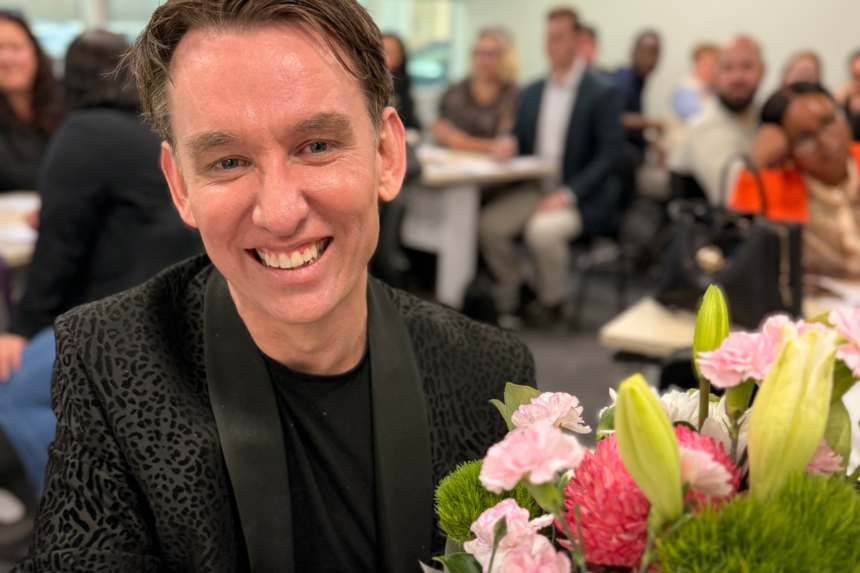
When Wayne Herbert walks into a room, you notice more than the fabulous sparkling shoes. You notice the quick wit, the warmth, the timing, the way he draws attention not by demanding it, but by deserving it. He is funny, sharp and generous. He is also impossible to reduce to a single story, which is exactly the point.
Because every day, Wayne and so many other people living with disabilities in our community meet barriers they did not build and do not deserve. Some are obvious: a locked accessible bathroom, an interview room up a flight of stairs, a workplace system that treats adjustment as inconvenience.
Others are quieter: the lowered expectation, the surprised praise, the “good on you” that sounds like kindness but lands like a ceiling.
Ableism at work is not only open discrimination. It is also the habit of imagining some people as a risk before they are seen as talent. It is the assumption that a disabled worker will need too much, cost too much, slow things down, disrupt the rhythm, or require charity rather than leadership. It can hide inside policies that look neutral, recruitment processes that reward sameness, and performance measures built around one narrow idea of what a “good worker” looks like.
Wayne has a way of making that visible.
He reminds us that comments like “you’re doing really well despite your disability” are not compliments.
They reveal an expectation that disability and excellence sit at opposite ends of the room. They quietly tell someone that the baseline was low, and that achievement is surprising. That is not inclusion. That is ableism with a smile.
The challenge for employers is to stop congratulating themselves for welcoming difference and start redesigning the workplace so difference can thrive.
This is not a niche issue. In 2022, the Australian Bureau of Statistics found that 5.5 million Australians, or 21.4 per cent of the population, had disability. Among people of working age with disability, 56.1 per cent were employed, compared with 82.3 per cent of people without disability. Only one-third of working-age people with disability were employed full-time, compared with more than half of people without disability. These numbers are not a reflection of talent. They are a reflection of access, attitudes and design.
One of the most powerful ideas Wayne offers is that low expectation is not kindness. It is a form of control. It decides in advance how far someone should go. It turns “reasonable adjustment” into a favour instead of a right. It makes employers comfortable with small openings instead of genuine opportunity.
A truly inclusive workplace asks better questions. Not “Can this person fit the way we have always done things?” but “What are we missing because we have only designed work for one kind of body, one kind of mind, one kind of energy, one kind of life?”
That shift matters. It moves disability inclusion away from the language of exception and into the language of quality. A ramp is not special treatment; it is a better entrance. Flexible work is not a loophole; it is a smarter way to keep skilled people. Clear communication, accessible technology, quiet spaces, inclusive rostering, respectful managers and practical adjustments are not burdens. They are signs of a workplace that knows people are human.
The pandemic proved that many changes once described as impossible could be made almost overnight when enough people needed them. Meetings moved online. Hours shifted. Workflows changed. People worked from home, from different cities, in different patterns. For disabled workers who had asked for flexibility for years, that moment carried a bitter lesson: often the barrier was never feasibility. It was willingness.
Challenging ableism means being honest about “merit” too. Workplaces love the word, but merit is often measured through familiarity. Who interviews well under pressure? Who can network after hours? Who can sit under fluorescent lights all day? Who can work full-time, on-site, without interruption, and call it commitment? If those measures exclude capable people, they are not neutral. They are filters.
A better approach to merit looks at contribution. It designs recruitment so candidates can show what they can do. It shares interview questions in advance where appropriate. It offers accessible formats without fuss. It makes workplace adjustments easy to request and quick to implement. It trains managers to respond with curiosity, not suspicion. It asks people what supports their best work, then believes them.
There is also joy in this work, and Wayne does not let us forget it. Inclusion is not only a compliance checklist or a policy document. It is the feeling of belonging without having to shrink. It is the colleague who asks, “Can I sit with you?” and means it. It is friendship, humour, shared standards and the everyday dignity of being expected to contribute fully. When workplaces get this right, they do not only become fairer. They become more alive.
For Canberra employers wondering where to begin, there are local pathways already doing the work.
Embrace Disability Group is a Canberra social enterprise built around “exceptional food, inclusive employment”. Through working at canteens, cafes and catering across Canberra and the surrounding region, it creates meaningful employment for people living with disabilities while serving workplaces, events and community gatherings. Supporting a business like Embrace is a practical way to back inclusive employment, see capability in action, and bring that learning back into your own workplace.
The Canberra Business Chamber’s Pledge on Disability Action is another clear step. The pledge asks businesses to recognise the importance of diversity and inclusion, acknowledge that inclusive workplaces can deliver better customer experiences and business outcomes, and commit to establishing a Disability Action Plan. The Chamber notes that each plan should be tailored to the business, not copied as a one-size-fits-all exercise, and that there is no cost to sign the pledge.
These programs matter because intention alone does not change a workplace. Action does. A pledge creates accountability.
A Disability Action Plan turns goodwill into decisions: Who is responsible? What will change? How will disabled staff and applicants be heard? Are bathrooms accessible and unlocked? Are job ads inclusive? Are managers confident? Are adjustments normalised? Are people present in leadership, not only in stories about inspiration?
Wayne’s message is not that employers need to “do more” in the exhausting, box-ticking sense. It is that they need to do differently. Rethink recruitment. Redesign performance. Raise expectations. Stop treating disabled workers as an act of generosity and start recognising the skill, wit, leadership and perspective already in front of you.
Most of us will experience disability, illness, injury or changed capacity at some point in our lives. The workplaces we design now are not just for “other people”. They are for our colleagues, our families, our future selves.
So let Wayne’s sparkling shoes catch your eye. Let his humour pull you in. Then let the message stay with you after the room goes quiet: disabled people are entitled to a better standard than this. And every employer has the power to help set it.
Start by taking the pledge here