Every week across Canberra and Queanbeyan, around 56 people are told, “You have cancer.” Lives are rearranged in an instant. Plans fall apart. New language, new routines, new fears arrive overnight.
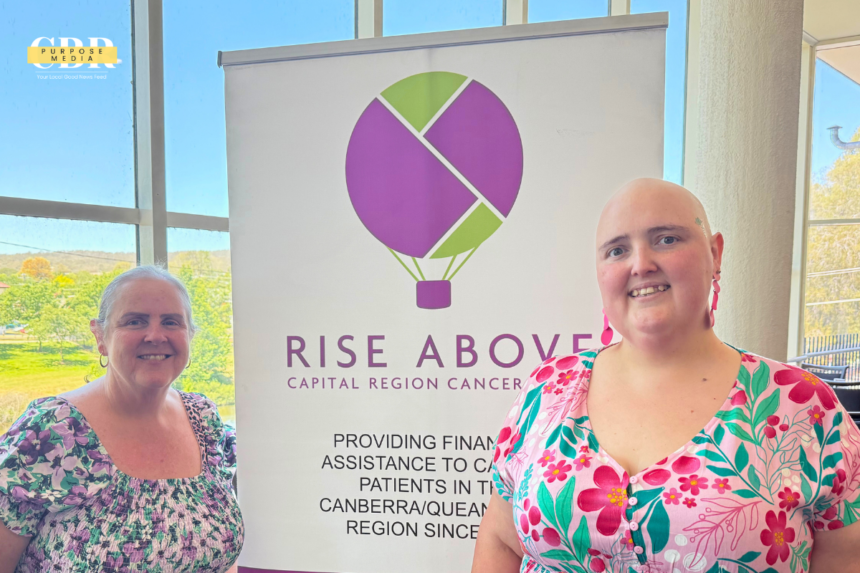
For Jerri, a thirty–something local with a bright pink dress, matching crocs and earrings to rival a Christmas tree, the moment those words were spoken felt like something else entirely.
Relief.
After two years of excruciating pain, mostly waved away as “just your period” or “you’re a woman, it’s normal”, she finally refused to leave hospital without a scan. That scan found Stage 4 uterine cancer. The oncologist sat her, her mum and their “little entourage” down and told them plainly.
“You’ve got cancer. We cannot cure it. We are looking at around three years.”
For two years she had questioned herself. Was it really that bad? Was it all in her head? She quit a job she loved because she thought she was having a breakdown. She planned to fix herself with walks, journaling and “doing all the right things”. The pain got worse anyway.
“It sounds strange,” Jerri says, “but I just felt relief to finally know what was wrong. I thought I was going crazy. All of a sudden it was not my fault. I had cancer. I had not done anything wrong. I was not being punished for not journaling.”
Diagnosis did not magically make the cancer less serious. It made her life make sense.
The advocate who lost her voice
Before cancer, Jerri’s job was advocacy. She describes herself, laughing, as the worker whose head was “already halfway through the window screen” when someone’s rights were being trampled.
On one of her first shifts, she marched into a bank to challenge a decision stopping a woman with Down syndrome accessing her own money. Staff remember her as “this attack dog of an advocate” who would not back down when something was unjust.
Yet when it came to her own body, she went quiet.
“Anyone who knows me would say I am not mild or timid. But in medical rooms, I was. When it came to advocating for my health, it just was not there.”
There is something brutally honest in what she says next.
“Sometimes I wish I could have cloned myself. I needed me standing in the room next to me. It is so much easier to advocate for another person than for yourself.”
She is not alone in that. Research by the University of Newcastle has shown that carers and partners can actually experience more anxiety than the person with cancer, partly because they are juggling information, appointments and fear all at once. When carers are under intense stress, patients’ anxiety often rises too.
Jerri now has language she wishes she had earlier.
“I am the expert in me. No matter what specialist is in the room, no one else has spent thirty years studying me. If it doesn’t feel right, it is not right.”
That sentence is a quiet rebellion against every “you’ll be fine” she was given when she was not fine at all.
Quality of life, not just quantity
By the time the diagnosis came, Jerri had already endured years of pain that most of the people around her did not fully grasp. Looking back, she remembers a birthday trip to Hobart where she could barely walk straight, trying to “breathe through” the pain rather than ask for medication.
Now that she finally has a good pain plan, she is stunned by what she lived through.
“I went to work. I drove. I engaged in life while I was in that much pain. I look back and go, ‘That is insane.’”
So when doctors started talking about treatment options, she was clear. Her goals are simple and uncompromising:
- To be as pain free as possible
- To be able to communicate with the people she loves
“If I can do those two things, I am happy to keep being here and to fight. If I cannot, then I do not want that.”
It is confronting to hear a young woman talk so calmly about trade–offs most of us hope we will never have to consider. But there is also power in it.
By naming her goals early and asking for palliative care support focused on pain management and communication, Jerri changed the tone of the care around her. Doctors stopped talking only about “how long” and began talking about “how well”. This is exactly what Australian palliative care and psycho–oncology experts have been calling for: care that centres quality of life and includes family, not just the disease.
Her mum admits she hated the term “palliative care” at first. It felt like giving up. Jerri sees it differently.
“Palliative care is not just the last few days. For some people it is years. I wanted them in my team early so I could stay engaged, not be knocked out with drugs, and be as comfortable as possible.”
“If you want to support me, support them”
Throughout our conversation, Jerri keeps circling back to the people around her. Her parents. Her friends. The group chat they jokingly call the “warriors and worriers” who swap candle videos each morning and check in on side effects.
“There is so much support for me,” she says. “My journey is only as easy as it is because of the people around me. If they are not supported, I am not supported.”
It is a line that should be written on the wall of every oncology ward.
Jerri is direct about what would help most and you see her advocacy bones shine.
- Information that is accessible in lots of ways, not just online portals
- The ability to talk to a real human and ask, “What does this mean?”
- Services that see carers as part of the team, not just “visitors”
“We are moving into more technology, and that is great. But we still have to make sure everyone can come along. Some of my friends, even younger than me, look at a hospital app and say, ‘I have no idea what to do.’”
The quiet magic of Rise Above – Capital Region Cancer Relief
When Jerri’s hair began to fall out, she took control, shaved it off and now jokes about how much she loves being bald.
“I wish I had done it before cancer,” she grins.
But it was not just the big identity moments that got her through. It was the small, practical pieces of wisdom she picked up from people who had been there before her.
That is where Rise Above – Capital Region Cancer Relief came in.
Rise Above is a local charity that has been supporting cancer patients and their families across Canberra and Queanbeyan for almost four decades. They provide financial assistance with cancer medications, chemotherapy costs, and essential household bills, across all ages and all cancer types, so that treatment does not have to mean choosing between food, fuel and pharmacy.
When Jerri and her mum walked into the Rise Above office, just one street from home, they did not just get a patient number. They got lived wisdom.
“Do you know you can have cooling gloves at the hospital? You just need to ask.”
“Have you tried a heat pack on your arm before chemo to help your veins?”
“You can set up an account at the pharmacy so you are not panicking at the counter.”
“Use a lint roller on your head when the tiny hairs start coming out.”
They sound like small things. They are not. Anyone who has sat in a chemo chair or watched someone they love do it knows how these tiny adjustments can mean the difference between coping and spiralling.
These are the tips that rarely make it into brochures, but they live in conversations, phone calls and community networks. Rise Above has built those networks so that each new patient does not have to start from scratch.
Why stories like Jerri’s matter
As Jerri talks, she is clear that she is not sharing her story for sympathy. She still laughs a lot. She still teases her mum. She still lights up when she talks about her work helping people navigate systems like the NDIS.
What she really wants is for her experience to shorten the suffering of the next person.
“This could have been resolved months earlier if someone had explained things properly,” she says. “I have seen that over and over again in my advocacy work. Five minutes of clear information could save someone six months of hell.”
That is why she is happy for her story to sit here, on a local platform, in a series literally called But I didn’t know…
Because there is a whole community of people in our region who did not know:
- They did not know financial support existed until a social worker quietly slid a brochure across a hospital bed.
- They did not know they were allowed to bring three friends to an appointment to help ask questions.
- They did not know that saying “I want quality of life, not just more time” was a valid medical goal.
And they did not know that a small Canberra charity, powered by donations and community events, would be there to help hold them up when everything else was falling apart.
This Christmas, you can be part of the story
Every year, Rise Above supports hundreds of patients across Canberra and Queanbeyan with practical help during treatment, including this year supporting more than 800 people in our region.
That support is funded almost entirely by community generosity. Sausage sizzles, local grants, people leaving a gift in their will. And one very festive fun run.
Join the Santa Run
On Thursday 18 December 2025, Running for Resilience will again transform the lake into a sea of red hats for the annual Santa Run.
- Meet from 5:30 pm at Queen Elizabeth Terrace, near The Jetty
- Santa sets off around 6 pm on the 5 km bridge–to–bridge loop
- Tickets are just $10 and include a Santa hat
- You can walk, run, push a pram or bring the dog
- All ages and all fitness levels are welcome
You do not have to be a “runner”. You just have to be willing to put on a hat, move your body, and say with your feet, “No one in this community faces cancer alone.”
If lacing up shoes is not your thing, there is another simple way to help.
Give a Christmas gift that really counts
A Christmas donation to Rise Above – Capital Region Cancer Relief helps to:
- Keep pharmacy tabs open for patients who cannot afford essential medications
- Cover the cost of chemo, scans and other treatment expenses
- Put fuel in the car for families travelling from the region into Canberra for care
- Ease the financial stress that weighs on carers so they can focus on what matters most
“Let’s make these years really great”
Jerri does not sugar–coat what she is facing. She speaks honestly about grief, anger and the unfairness of it all. But she keeps coming back to one thing.
“I know we are angry and upset. I know it sucks. But let’s make a really great couple of years. Let’s make them really great.”
That is what Rise Above is working for, patient by patient, bill by bill, conversation by conversation.
So if you are looking for a way to give back this Christmas that is local, real and deeply practical, consider this your invitation:
Grab a Santa hat. Join the Santa Run. Or make a donation to Rise Above so that the next person who hears “You have cancer” has a little less to fear and a lot more support behind them.
Because no one should have to navigate this alone. And no one should ever have to learn the hard way what help was there all along.