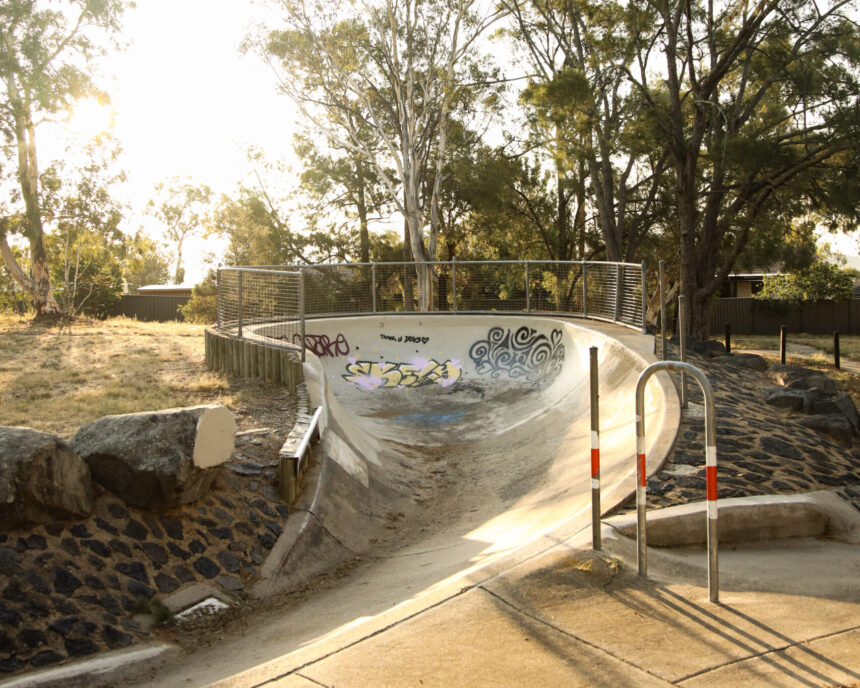
It’s Saturday morning in Canberra and everyone is outside. Families have spread themselves across the green space, there are teenagers and adults on the playgrounds, ovals and courts, and people are spilling out of the cafes onto the footpath. At the skatepark, a kid drops in for the first time, falls, gets back up, and someone decades older who’s never met them cheers, “you nearly had it!”, with the enthusiasm of an old friend. On Saturday 3 October at Tuggeranong Skatepark, the government will be on hand with a draft skate strategy, asking Canberrans what they want from the places they skate.
Skateparks are among the few pieces of community infrastructure that ask nothing of you at the door. No membership, no fee, no form, no referral, no waitlist. For a young person who doesn’t see themselves in team sport, or a parent who can’t cover another set of fees, that matters more than it might seem. Because of that, the integrity of these spaces matters, clear and accessible entry points matter, and after more than a decade without a new skatepark in Canberra, this draft strategy matters.
How this started
The Draft ACT Skate Strategy was born out of two petitions, which launched an official investigation, called a parliamentary inquiry. That inquiry, after hearing from almost 400 Canberrans, set out 33 recommendations, the second of these being that the government write a skate strategy. This draft is the result, and you now get to have your say before it’s finalised.
What the draft says
The Skate Strategy is built around six objectives, namely:
- Plan skateparks into new suburbs from the start.
- Build new ones designed for people still learning as well as riders who are already good.
- Recognise Canberra’s skate history.
- Treat skating as a legitimate sport.
- Get more people into skate sports, especially women and girls, gender-diverse people, kids and people with disability.
- Look after the parks we have, using people who know how to repair a skatepark.
The draft says some facilities sit in poor or very poor condition, admits that they lack modern street features, and note that local skaters travel interstate to train.
Six skaters, one conclusion
Six Canberra skaters answered questions for this article, separately. When asked what the parks are missing, they all said close to the same thing, and it matches the draft’s second objective.
Two of the skaters are brothers who both learned at Tuggeranong Skatepark. TB was eight, it was 1998, he went with his family and he loved it. Rbjiggy, the older of the two, was eleven or twelve. Nearly thirty years on they both still skate the same park, and Rbjiggy still lives in Tuggeranong.
It’s also the park TB now calls the worst skate infrastructure in Canberra, outdated and hard to use, and one he says everyone has given up on. His objection isn’t the holes and cracks, though he gets to those. It’s who the park was built for. He suggests that the big ramps are for the best of the best and for one style of riding, and what it needs is more options, including smaller ramps, so more people can use it.
Rbjiggy widens feedback to the southside, naming Lanyon and MacArthur too, outdated and in his view not built by proper skatepark builders. What’s improved, he says, is the Canberra Skateboarding Association running lessons, and the obstacles that were missing, which skaters went ahead and built themselves. Rbjiggy skates still, well into his late thirties, describing joy, happiness and purpose, and an energy he hasn’t found anywhere else. “It makes you feel free.”
Jeremy, from Campbell, says that when he hasn’t skated for a while his life feels like it’s missing something. He considers the design of skate parks to be a big part of the issue. Skaters want variety rather than the same features at every park, and bigger isn’t always better, because a little goes a long way if it’s used well.
Elijah, from Banks, would put a new skatepark in every major area of Canberra, and an indoor facility with a gym and training space, so local skaters could work towards competing seriously without leaving town. Building new parks, he says, has slowed to a halt. He keeps at it for a reason he finds hard to explain to anyone outside it. “I love it, you have to do the things you love,” he says. “It’s the only feeling you can describe to other skaters.” What he wants the people writing the strategy to understand is simple. “Build the right parks and the people will come.”
What it’s like to be the one learning
So far the skaters have described parks they can already ride, but two of them know what it’s like to turn up before you can. Ali, who skated through her twenties and doesn’t now, found busy parks intimidating, and not because anyone was unfriendly. “You don’t want to fall over in front of a crowd, or hit someone because you can’t yet stop”. So she went to the quieter parks, Weston mostly, and practised on the basketball court at Woden before trying little parts of the skatepark.
Shelby, who has skated on and off since she was a kid and is now raising kids who skate, names the same barrier. She says that in comparison to Knoxville, Tennessee where she grew up, Canberra has an amazing amount of skate infrastructure. The harder part is entering the culture of the park as a beginner, understanding the flow, not wanting to get in someone’s way, or feeling watched. She still feels like an outsider sometimes, even after years in board shops and around board sports.
Both women want the same thing, which is somewhere to work up from. Shelby wants obvious beginner and progression areas, and somewhere families can sit while they watch. Ali brings the same idea to life with a description that numbers and colours sections of the parks, so one is red and completely flat, two is orange and something very small to roll over, so a parent who doesn’t skate at all would know exactly where to start, and progress their kid.
Several skaters pointed a beginner to the same place. The Canberra Skateboarding Association runs free learn-to-skateboard sessions at skateparks around Canberra through the year, with skateboards and helmets provided. One registration covers every session, and anyone under 18 needs a parent or guardian signature. Dates and forms are at canberraskateboarding.org.
On girls staying in the sport
The ACT Government’s own urban design research found that girls tend to stop using parks around the age of twelve. One thing has genuinely changed, Shelby says. As a millennial girl she couldn’t have named a professional female skater. Now girls can open Instagram and see women and girls skating at every level, which she says really changes what feels possible.
She suggests that around that age puberty, body confidence and self-consciousness all arrive at once, and if you’re also one of the only girls at the park, skating falls away easily. When asked what is needed for her daughter to still be skating in five or six years, she says “girls skating would need to feel completely normal: friends who skate, female role models, coaching or clubs, and somewhere to keep learning without feeling on display”.
Her fix is to make the way in more social, which is roughly what she did herself when she started CBR SK8 MUMS in 2022. She longs for regular girls’ and family beginner sessions, and skateboard clubs in schools, the way her old school back home ran a climbing team. Canberra already has the skateparks, she points out. The community around them is the part still to be built.
Who feels welcome, and what gets in the way
All our skaters were unanimous when speaking about barriers: the people aren’t the problem. Rbjiggy says the skate community welcomes everyone, and that he sees support workers at Tuggeranong with the people in their care. TB says 99 per cent of skateboarders are the most friendly people you could meet.
Jeremy adds that the culture inside and outside skating has been a significant barrier to gender diversity, and that shifting it still takes active effort.
What that leaves is a community that wants to grow and invites newcomers, facing a physical environment that makes it harder than it needs to be. The draft skate strategy notes both, and asks for facilities designed for people who are still learning. What gets built in response will be shaped by who says something before 5 October.
What’s still open
Not everything the inquiry raised has made this draft. It recommended an all-weather facility so people can skate through a Canberra winter. Asked what they’d build with unlimited money, Rbjiggy and Elijah both suggested the same thing, an indoor, all-weather facility. The strategy being finalised sets direction rather than funding, which is allocated separately through the budget, so priorities are the part still up for grabs, and the directorate has said it wants to hear from all types of skaters about what matters most.
How to have your say
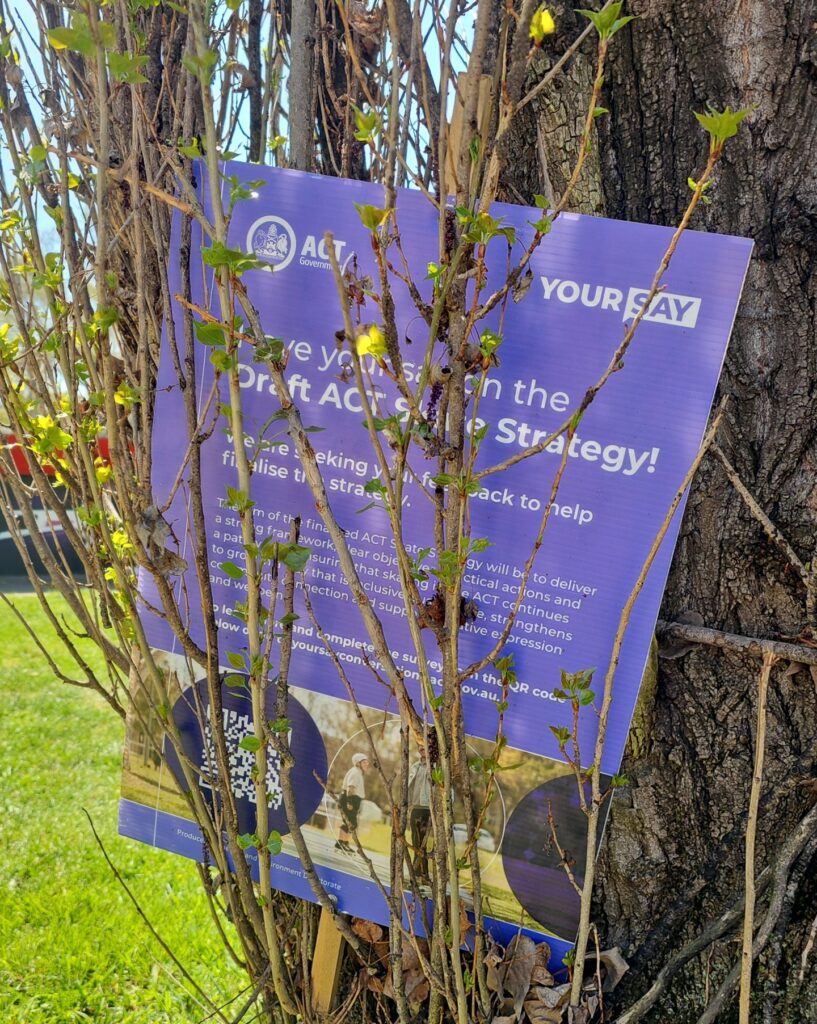
If you want to share your thoughts on the Draft Skate Strategy, the survey is on YourSay at yoursayconversations.act.gov.au, under Draft ACT Skate Strategy. Feedback can also go to communityengagement@act.gov.au, and a short paragraph counts as much as a formal submission.
One community pop-up is left. Tuggeranong Skatepark, 25 Bartlet Place in Greenway, Saturday 3 October, 10am to 12pm.
Feedback closes Monday 5 October. You don’t need to be an expert, or a skater, or to have read the document, to have a view worth recording, so get your skates on (sorry, had to!) and join the pop up on Saturday 3 October!