There is something deeply unsettling about walking through a house built for care and knowing it may soon stand empty.
Not unfinished. Not forgotten. Not unwanted.
Empty.
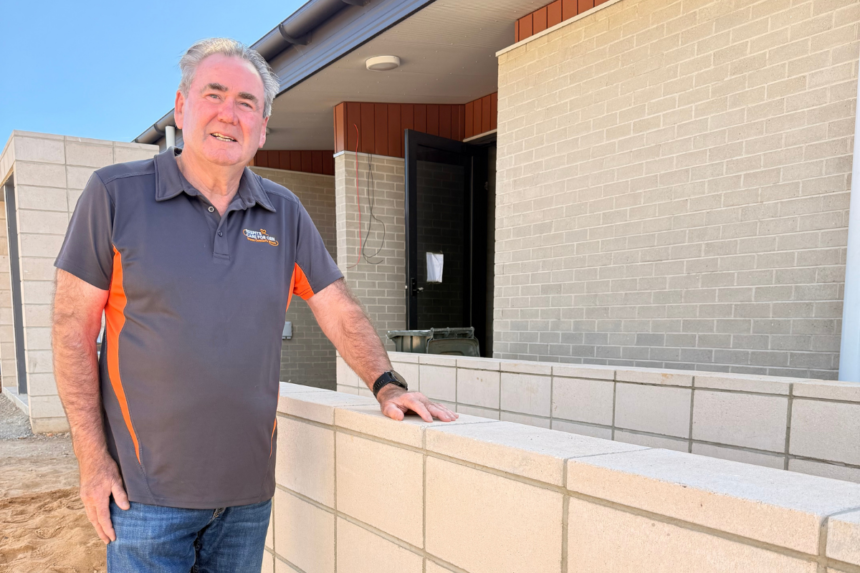
At the front entrance of Yvonne Kuskiri House, you can already imagine the life it was designed to hold. This is not an institution. It does not feel cold or clinical. It feels like a big house, which is exactly how Paul Walshe describes it as he walks through the site.
Inside, there is an office for the provider who will one day run the place. Beside it, sleeping quarters and an ensuite, because someone is meant to be here all the time. Not dropping in. Not checking a roster from afar. Here.
“Twenty-four hours a day, seven days a week,” Paul says.
It is easy to picture the quiet relief that would bring to a family who has been carrying too much for too long.
Down one wing are three bedrooms. There is an interconnecting room that can be opened or locked, depending on what a family needs. Maybe a carer stays overnight. Maybe they do not. Maybe, for the first time in months or years, they go home and sleep without keeping one ear open.
There are bathrooms, storage areas, a fully functional disability bathroom, and a kitchen and living space waiting for families to fill it. The lounge area is open and sunlit, with a divider planned so people can sit together or find a quieter corner.
You can imagine someone resting there in the afternoon light.
You can imagine a family visiting without the harshness of hospital walls around them.
You can imagine a young person with a chronic or terminal illness staying somewhere that does not treat them as if they are old before their time.
That is the point of Yvonne Kuskiri House.
It was never meant to be high-care hospital replacement. It was designed as respite. A place where people aged 18 to 60 living with terminal or chronic illness could stay for up to two weeks, with the “same care here as they would get at home,” Paul says.
Their usual nurse could still visit. Professional carers would support them. Families could pause.
Not disappear. Not stop loving. Just pause.
Because carers need pauses.
This whole project began with Yvonne Kuskiri, who knew that truth intimately. Her son Steven, in his early 50s, had a brain tumour. Yvonne and her husband Joey were his carers. One day, a nurse saw what so many carers try to hide and said the words that sit at the heart of this house.
“You need to have a break. You’re burning out.”
But there was nowhere appropriate for Steven to go, other than a nursing home. Paul remembers the reality of that option plainly: Steven shared a room with two men in their 90s who had dementia, even though Steven was still mentally well, mobile, and far too young for that environment.
That experience became the spark.
Yvonne, who founded the ACT and Monaro Cancer Support Group, now Rise Above, around her dining room table in Queanbeyan, did what she had always done. She gathered people. She pushed. She asked. She refused to accept that this was just how things had to be.
In 2016, she called Paul and said, “I need your help.”
Nearly a decade later, he is still here.
The building itself has been a battle. Initial government commitments of $750,000 from the NSW Government, matched by the Commonwealth, were expected to cover construction. Then COVID hit. Costs escalated. The project that was once costed at $1.5 million became a $2.6 million build.
There were petitions, grants, fundraising and election commitments. There were council delays, approvals that took months and months, and a building classification that triggered expensive fire compliance requirements. Construction stopped for four to five months before the issue was resolved.
Now, finally, the site is moving again.
Paul had been at a site meeting the morning of the walkthrough. His summary was simple: “full steam ahead.” The car park is due to go in. Concreting is coming. Tiling is about to begin in the kitchen and bathrooms. Paint will follow. The target is completion by the end of June.
And that is where the heartbreak sharpens.
Because the building may be nearly ready, but the operating funding is not.
Under the grant agreements, Yvonne Kuskiri House must operate as a respite care facility. That is the promise. That is the purpose. Yet no recurrent funding has been secured to run it.
Paul has been warning governments about this for years.
“We can build it, but we need government funding to run the facility,” he recalls saying.
The estimated operating cost is around $1.6 million a year. There is some Commonwealth operations funding available to help kickstart the process, and $200,000 was released to go to market to find a provider. A consultant was engaged. Providers were approached. Four were narrowed down.
All four declined to tender.
Not because they did not believe in the model. Not because the need was unclear. But because without government funding, they could not make it financially viable.
So here we are.
A house designed for exhausted carers and younger people with serious illness may soon be complete, but unused.
“It’s gonna sit here as a white elephant,” Paul says, if funding is not found.
That phrase is hard to shake when you are standing in a place like this.
Because it should not be a white elephant. It should be a kitchen with the kettle on. It should be a bedroom where someone feels safe. It should be a lounge room where a family can visit without the noise and fear of hospital around them. It should be a place where a carer can go home, close the door, and breathe.
Maybe they sleep.
Maybe they get their hair done.
Maybe they do the grocery shopping without panic.
Maybe they watch a miniseries and remember, briefly, that they are a person too.
Then they come back. Recharged. Ready to keep going.
That is not indulgence. That is survival.
Carers hold up our health system in ways that are too often invisible until they collapse. They keep people at home. They manage medication, appointments, meals, distress, pain, transport, fear and love. They do it because they must. They do it because they care.
But care should not mean being left alone until burnout becomes inevitable.
Yvonne Kuskiri House is a practical answer to a human problem. It is built on lived experience, community effort and years of advocacy. It carries the name of a woman who knew what was missing and decided to do something about it.
Paul says he wants to see her name on the building.
“I just wanna see it finished,” he says. “I wanna see Yvonne’s name along here.”
More than that, he wants to be able to say they delivered what she asked for.
“We’ve done what she wanted us to do.”
That should matter.
It should matter to governments. It should matter to health departments. It should matter to anyone who has ever loved someone through illness and wondered how much longer they could keep going.
This house should not be empty.
Not when the need is so clear.
Not when the walls are already standing.
Not when families are waiting for the kind of help that lets them keep caring.
A finished building with locked doors is not a solution. It is a failure of imagination, planning and responsibility.
Yvonne Kuskiri House was built for people. Now it needs the funding to let them in.
Keep up to date on this house by visiting Respite Care for QBN or following their Facebook page. Website