
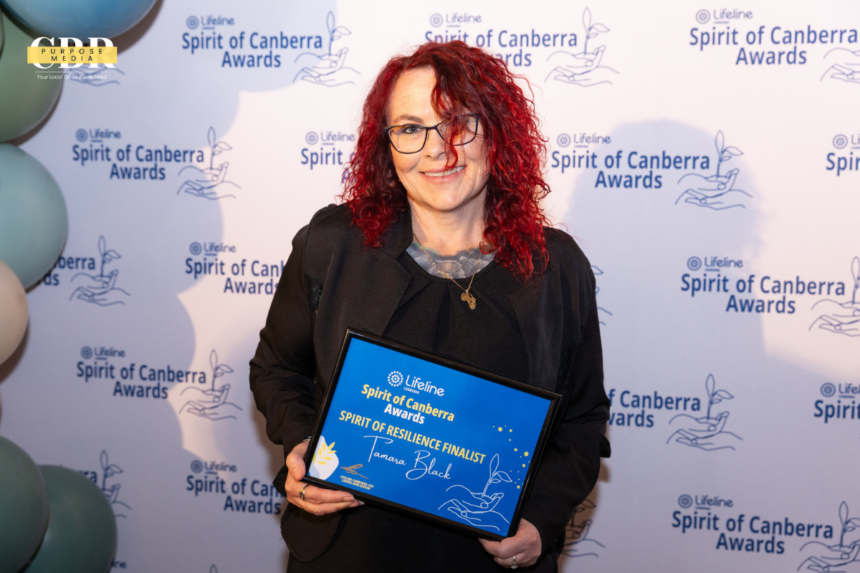
Tamara Black is known in Canberra’s disability and health sectors by a simple, telling nickname: the Collaborator.
It is not a title she gave herself. It is one she earned, slowly and consistently, by bringing people together when systems felt fragmented, when families felt exhausted, and when services felt harder to navigate than they needed to be.
Last year, Tamara was recognised as a finalist in the Spirit of Resilience category at the Lifeline Spirit of Canberra Awards. The acknowledgement mattered, but it is not where her story begins, and it is certainly not where it ends. Today, her work is less about recognition and more about building something practical, human and enduring in the disability sector.
Beating the odds early
Tamara’s understanding of resilience is not theoretical. It is lived.
She was removed from school at 15 and became a mum at 16. For many, that combination becomes a permanent label. For Tamara, it became a motivator.
Raising three children while navigating early adulthood forced her to grow up quickly, but it also sharpened her sense of responsibility and empathy. She learned early what it meant to advocate, to problem-solve, and to keep moving forward when the path ahead was unclear.
Those early experiences shaped the way she approaches both life and work. There is no judgement in how she meets people, only a deep awareness that circumstances do not define capability.
A career shaped by people, not titles
Over the years, Tamara built a career across disability employment, corrections and child protection. Each role exposed her to different parts of the social system, but a common thread ran through them all: people navigating complex structures at their most vulnerable moments.
Eventually, she returned to where she felt she could make the greatest difference, the disability sector.
Today, Tamara works as a Client Services Manager, with a strong focus on Supported Independent Living (SIL) and Short Term Accommodation (STA) development. It is highly technical work, sitting at the intersection of policy, funding, housing and care. But for Tamara, the purpose is always clear.
“The people are not just an NDIS number or a dollar sign,” she says. “They are human beings with abilities, who need assistance to live their lives independently and free of judgement.”
That belief informs every decision she makes, from how services are designed to how conversations are held with participants and families. Independence, in her view, is not about doing everything alone. It is about being supported in ways that respect autonomy, dignity and choice.
Grief, loss and continuing to build
Tamara’s resilience has also been tested by profound personal loss. She lost her husband in a car accident. She later lost her mother to cancer.
Grief did not stop her work, but it did deepen it.
Rather than withdrawing, Tamara kept building community. She understands firsthand how quickly life can change, and how essential connection becomes in those moments. That understanding sits quietly beneath her leadership, shaping how she shows up for others without ever centering herself in the story.
It is this combination of strength and softness that people respond to.
The power of collaboration
One of Tamara’s most impactful contributions to the sector exists outside formal organisational structures.
Seeing how fragmented services could be, and how often providers worked in silos, she founded bi-monthly collaboration events in Canberra and Goulburn. These free forums bring together allied health professionals, disability providers and health stakeholders to share services, build referral pathways and learn from one another.
There is no cost to attend. No sales pitch. No hierarchy.
Just people in a room, sharing what they know so others can do their jobs better.
In a system often strained by funding pressures and competition, this approach is quietly radical. Tamara does not believe collaboration weakens organisations. She believes it strengthens outcomes.
Over time, these gatherings have built trust, improved service navigation and reduced duplication. Families benefit. Participants experience smoother transitions. Providers gain clarity about who does what, and who to call when something is not working.
It is systems change achieved not through policy reform, but through relationships.
A practical approach to resilience
Tamara’s resilience is not performative. It is practical and optimistic.
See a need.
Bring people together.
Create impact.
That philosophy has guided her through every stage of her life and career. It is also why she is now speaking at sector forums and contributing to broader conversations about how disability services can do better.
She is currently piloting new Specialist Disability Accommodation (SDA) solutions, focused on transitioning people from hospital into stable, long-term homes. The work addresses a critical gap, people who are medically ready to leave hospital but have nowhere appropriate to go.
For Tamara, housing is not just infrastructure. It is the foundation of dignity, safety and independence. A “forever home” is not a nice-to-have; it is a human right.
Normalising support, challenging shame
One of Tamara’s strongest messages is also one of her simplest.
No matter what you are going through, there is someone else out there going through something similar. Seeking support or guidance is not shameful, she says.
This belief underpins her advocacy across disability and health settings. Too often, people delay asking for help because of stigma, fear or exhaustion. Tamara works to normalise support as a strength, not a failure.
Independence, in her view, includes knowing when to lean on others.
A poet’s lens on human systems
There is another layer to Tamara that people discover over time.
As a young person, she was a poet. Some of her work was published in the paper during her school years. That creative instinct never fully left her.
It shows in the way she listens, the language she chooses, and her ability to sit with complexity without rushing to fix it. In a sector dominated by compliance and process, that human lens matters.
It reminds people that systems exist to serve lives, not the other way around.
Tamara Black does not seek the spotlight. She builds tables and invites people to sit around them.
She champions working alongside willing providers, not against them. She believes that better outcomes come from shared knowledge, mutual respect and collective responsibility.
In Canberra and beyond, her impact is felt in quieter ways: a smoother referral, a collaborative phone call, a person finally moving into a home that feels safe.
Tamara’s work is a reminder that purpose is not always loud. Sometimes it looks like showing up, again and again, and choosing connection over competition.
That is the kind of leadership that lasts.




Tamara is an amazing human inside out ,her dedication to her work is amazing and her compassion for her clients is outstanding
Always going above and beyond to see them happy and achieving their goals.
This story is amazing just like the person Tamara is.